
xalution develops concrete AI agents for Dynamics 365 together with Odlo and Griesser
How can AI agents be meaningfully integrated into real ERP processes? Not as a theoretical vision of the future, but as a concrete solution for manual, repetitive, and time-consuming tasks.
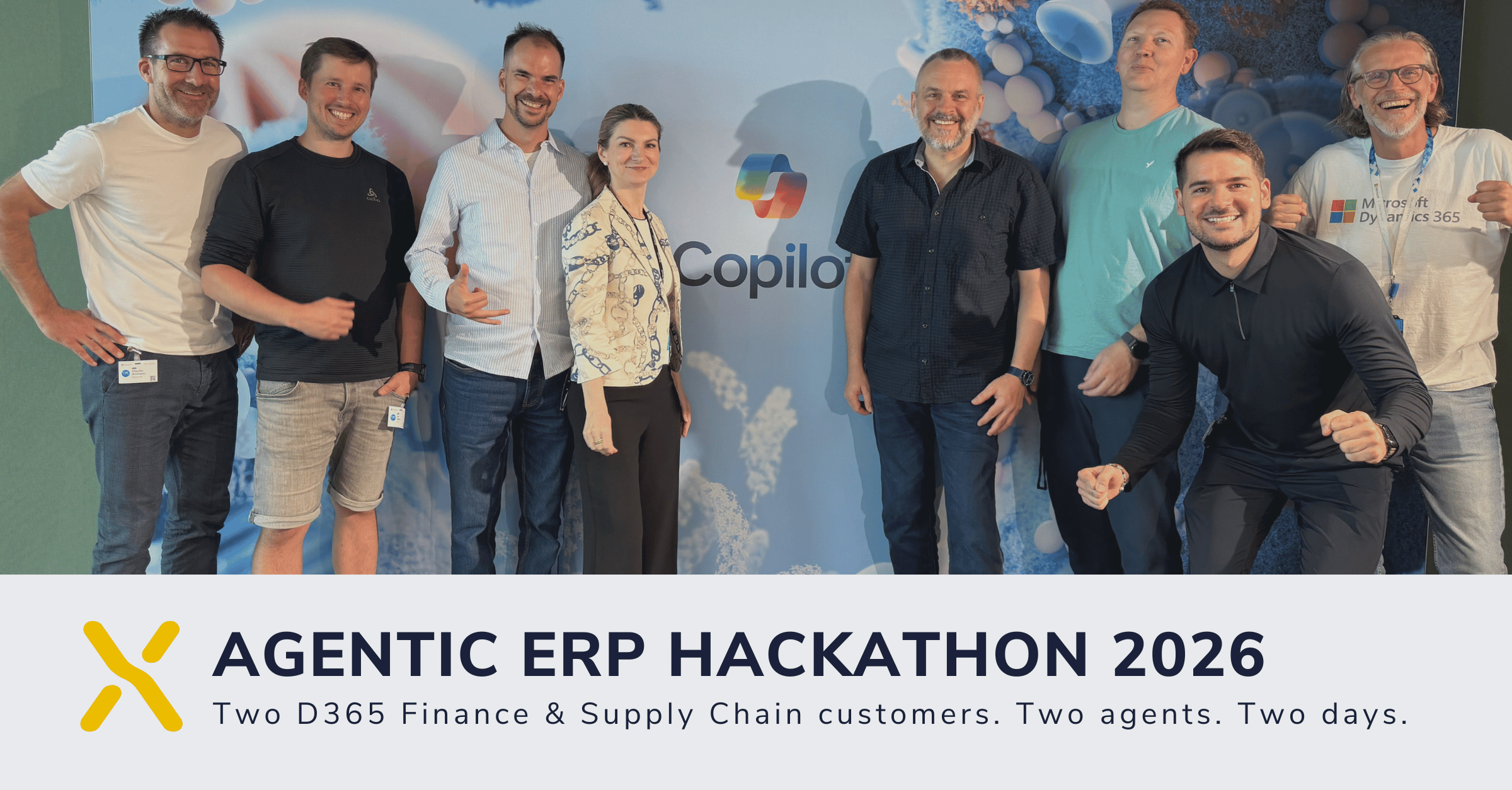
That was exactly the focus of the Agentic ERP Hackathon hosted by Microsoft on July 7 and 8, 2026. Five customers and four selected Microsoft partners spent two days working on concrete application scenarios around Microsoft Dynamics 365 Finance and Supply Chain Management.
xalution took part together with two customers at once: Odlo and Griesser.
A New Pop-up Store in Minutes
Odlo regularly opens new pop-up stores. However, setting up a new store in Dynamics 365 Finance and Supply Chain Management involves considerable manual effort.
Master data has to be created, configurations made, and various process steps carried out correctly. Fully setting up a new store normally takes one to two days.
Together with Odlo, the xalution team developed an agent during the hackathon that takes over this task based on just a few key inputs. From these, the agent creates a complete new store directly in Dynamics 365.
This shortened the previous process from one to two days down to just a few minutes.
The Pop-up Store Creation Agent also convinced the jury. The joint team from Odlo and xalution won the hackathon with this scenario.
The result shows the potential that lies in clearly defined, frequently recurring ERP processes. Especially where employees currently gather information from various sources and repeat the same manual steps over and over, agents can deliver immediately visible value.
Detecting Master Data Errors Before They Cause Problems
Together with Griesser, xalution worked on a second scenario. Here the focus was not on process speed, but on the quality of master data.
Incorrect country codes or inconsistent spellings may seem insignificant at first glance. Such discrepancies often only become visible once they affect reports, integrations, or downstream business processes.
The jointly developed agent analyzes master data, detects possible errors, and suggests appropriate corrections. The decision on the actual change remains with the human.
This scenario demonstrates another strength of Agentic ERP. Agents can not only speed up work steps; they can also help employees spot problems earlier and make better-informed decisions.
From Hackathon Prototype to Production-Ready Solution
By the end of the hackathon, the two scenarios had reached different levels of maturity. While the agent for Odlo could already set up a complete store, the Griesser scenario focused on detecting errors and recommending suitable corrections.
However, a working prototype is not yet a production-ready enterprise solution. Before it can be used in daily operations, questions around permissions, data quality, control mechanisms, error handling, and secure execution within the ERP must be resolved, among other things.
Especially for business-critical processes, it must be clearly defined which steps an agent may carry out independently and where human review is required.
Nevertheless, the hackathon clearly showed how quickly a concrete process idea can turn into a working agent when domain expertise from the business, process understanding, and technical Dynamics 365 skills come together.
Agentic ERP Starts with the Right Use Case
Not every process needs an agent. Particularly well-suited are clearly defined tasks that currently require a lot of manual work, recur regularly, and are based on existing data and traceable rules.
So the best starting point is not the question of where AI could be used everywhere. What matters is identifying where time is currently being lost, where errors occur, or where employees repeatedly have to gather the same information.
Would you like to find out which processes in your Dynamics 365 environment are suitable for using an agent?
In a no-obligation conversation, we analyze your starting situation together and identify possible use cases. Based on that, a focused workshop or a concrete proof of concept can follow.